In the past I wrote updates about my training, one at the 3 years mark and one at the 5 years mark. Now it’s 2020, and it’s been 8 years since I started Contortion. What it amazes me is how much I can still learn, in terms of the smallest, most detailed form of information about my body. Each time I train I observe how I talk to myself, how I deal with emotions and training, how I decide beforehand what I want to accomplish and how I go about it during the session. Once you have down the physical technicality, you find yourself spending a lot of time training your thoughts to be of support rather than a sabotage and how much your parasympathetic nervous system need to work in order to calm your fight or flight response (sympathetic system) during intense sessions. Improvement as in “learning new tricks” eventually slows down, and it becomes all about endurance, mastering, polishing, calm, controlled, pain-free training.
A big realization that I had was: muscles need to be warmed up dynamically and passively lengthened, but then it’s important to be able to activate them in order to make the deep passive ranges utilizable. Activation means contracting the muscles (either isometric, eccentric or concentric contraction), in this case from an extended position (like contract isometrically your hip flexors when in lunge pose). That way your muscles will feel in control and therefore safe and able to go even deeper. Only using passive flexibility will make the muscles weak and will lead inevitably to injury.
Another aspect of training that I need to always consider is how fear and self doubt can creep in at any time if not supervised. You can’t never relax with that, always have to monitor what you tell yourself, do you set yourself up for failure or success? What words do you use when training? What helps you stay in the ‘zone’? I catch myself sometimes being negative or frustrated if my session doesn’t go as planned. But I learned to make the best out of it. It’s not always about the perfect training day, sometimes showing up and do the damn thing, no matter what, is what will take you further, more than anything. Repetition and consistency are the building blocks of any discipline and skill.
What else helps me to train, beside a positive, low expectation, present, mindful approach? Music really helps (and COFFEE). Music has proven to be so important when feeling unmotivated or distracted. Also, setting my intensions before starting a session really helps me to stay focus. I visualize what I will work on, even if it ends up being a difficult, not so bendy session, I try to follow what I previously decided to be working on, maybe with a few adjustments. You can’t show up to your training unprepared or without a plan, that’s why having a training routine is so important. Yes, scheduling your training days is another aspect of being successful at what you do. On Sunday night I usually plan my training for the week. I don’t wake up and do what I feel. If you want freedom in your body, you need planning ahead and a strict discipline.
Also, 8 years in this training, I definitely know what parts of my body are more prone to be open and what aren’t. I did focus extensively on the least flexible parts of my body (shoulders, thoracic area): they got better, but still require a lot of work and attention. I had to be careful also as in pushing limits without creating injuries, that’s why I added consistent physical therapy work: prehab, rehab (for old injuries) and overall a lot more strengthening and conditioning. That was how I got rid of ongoing past pain in low back and shoulders (previously injured with excessive passive flexibility and no strengthening!). Overall, you need strengthening as much as lengthening, and the more flexible you become, the more strengthening you have to do. In the beginning you’re just too stiff to think of active flexibility or strengthening a range, because your range is too narrow; but then things change, more room to move in, more room to activate and strengthen – but you need to make that room first (with passive and dynamic work, for me dynamic is just moving in the range you’re allowed to without a warm up, for example arms circles).
Another thought I had was that no matter how much care you’ll put into it, some injuries are meant to stay. Your job is not making them worse, just helping your body to live with them, and that will mean sometimes avoiding certain exercises or tricks that only causes pain and no benefit whatsoever. I’m not telling you don’t do something that’s uncomfortable, I’m telling you search for a better option. If you really want to do a certain trick or pose, look for a variation that helps you body instead of worsening an old or current injury. Or let it go altogether for a while and let your body heal. Or maybe never do that pose again! Why obsessing over? I have tried all tricks possible (minus a couple I was never interested in like Marinelli bend/mouthpiece and one hand handstand) but then let go of a few that truly just bothered my body badly. No matter how much I’d warm up, I’d find no growth or new learnings from them. I sometimes do them just to tell myself I can do them if I want to, but I don’t enjoy them at all. Which lead me to another thing I learned… training correctly for your body PROPORTIONS.
I have long legs, tall body (5 11/179 cm). Some poses and tricks will look and feel great on my body, others not. Long legs means a lot of weight for lower back. Tall body means harder to balance (I still do it because I love the challenge and it feels great on shoulders). A shorter body will overall have shorter limbs, better balance and an easier access to some tricks (it’s not a case circus performers are usually short). But I don’t use my height as an excuse, just an observation to pick the best tricks for my body type.
Beside proportions, I want to go back to what body parts tend to bend more and what tend to bend less. Generically, you’re either hip dominant or back dominant: people with great splits have usually great low back and hips, tight upper back and shoulders. The body will always try to be using the dominant parts. It ‘s been fun accessing more parts of my body where I never felt any flexibility there, but overall (especially when gravity plays a role) the body will use the dominant parts. So you can let it do that, but always try to address the less flexible parts to create even flexibility throughout the whole body. Contrary, if you easily backbend, you’ll have great shoulders and spine mobility but tight hips, glutes, adductors and hamstrings. Some lucky people will have it all! Those I call the naturally flexible people.
So, to sum it all… some tricks your beautiful unique body will struggle with, but then embrace and accept, and grow from. Others your body won’t love, no matter how hard you try. It’s okay, we are all different and it’s perfect like that. Don’t obsess over tricks your body just hurt from no matter the approach you use (it can takes years to figure out which tricks).
A few more thoughts…
This training will always be very tiring and time consuming. You won’t be able to let go of warm up or shorten your sessions. Even if your warm up can be shorter, you have so much to practice that 3 or 3 and a half hours are standard ( I do train all hard tricks weekly and rotate the others just to keep them fresh). This training is easy to lose and let go. It needs constant care, love and attention. So I understand if someone eventually wants to walk away or approach something else. Things change! But I grew to love my practice and I spent so much time and effort, I can’t let it go.
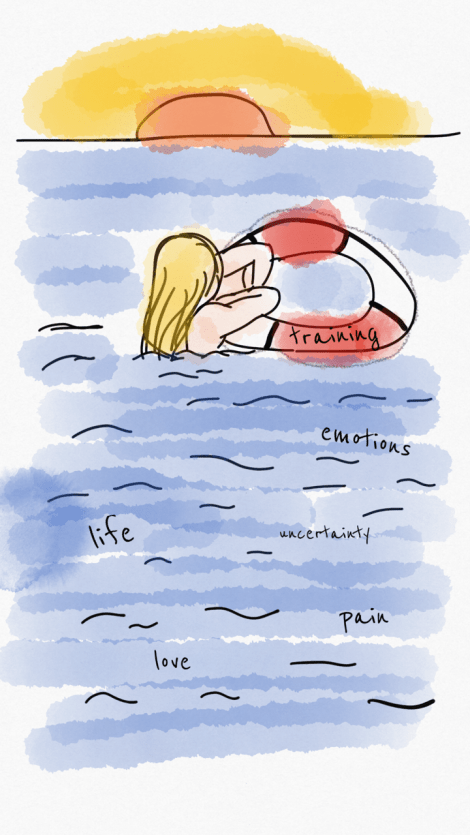
And lastly… some days STILL just suck. Plain SUCK. Stiffness, mood swings, freaking COVID 19 and all the uncertainty of 2020 make you question why are you even putting yourself through the dreaded sessions. Well. It’s what gives a sense to all of this, it’s the lifebelt that keeps me afloat, grounded, connected, hopeful. So I keep going, no matter what.
Thank you for reading…
Till next time
S
 Sofia Venanzetti
Love this
Thank you so much for writing this article. It really resonates with me and is a great reminder to keep persevering and persisting with my own contortion training. I started contortion very late in life, in my late 20s and now I’m almost mid-30s. Honestly the progress is slow and painful at times, I wonder if its healthy for my body in the long term. However I’ve come a long way and am seeing progress, slowly but surely. The satisfaction of achieving some goals has blown my mind what the human body is capable of with discipline and time! Contortion has taught me how to listen to my body, be patient, be firm but kind. Keep being amazing and inspiring, I love your writing and hope you know you help more people than you realise!
Thank you so much. I’m in the same age range as you. And I agree completely about what you said! Especially I’ve questioned sometimes if it was healthy! Then I know that with lot of care and attention it is.thank you again!
Love your content!
Thank you!
Definitely helped my perspective ..Thanks Sofia . I love to belly dance and Latin and these range of motion tips which u are a Master hep me so much your the best.
Thank you!!
Love it!
– Sophie