I haven’t posted about Contortion in a while. So today I’m coming in hot with something I’ve been thinking about. What does a journey in Contortion look like? Is it for everyone? Now that I’ve been training for 12+ years, I can tell you about it.
Contortion is an art form that requires intense discipline and overall a call for flexibility, meaning you gotta feel a strong enough desire for it to begin with as it’s a long and challenging journey, yet very rewarding, mentally and physically. I’m going to try to explain what this journey looks like for different types of people.
I’ll mainly discuss two categories: people with either natural upper/mid back flexibility or low back/hips flexibility, and non naturally flexible people. Of course there are degrees for each category (some being extremely flexible others just above average. I will discuss mostly adults, above the age of 18). There is also another category which is for people flexible “all over” (upper and lower body) but this is the smallest percentage there is so I’ll keep it out for now.
Level 1, beginner
This is an introductory level where a person learns the basics of Contortion (like foot grab in lunge, bridge, cheststand, bow pose and splits). There is great emphasis on warm ups and passive flexibility with the introduction of also some conditioning, technique and injury prevention. Most times students here don’t have enough range to use much active flexibility (especially the non naturally flexible) and they’re still learning about pain tolerance, breathing and nervous system adaptation (how to regulate fear and fight or flight response, tightening vs activating and so on). This stage takes on average 2-4 years for non natural people and 1-2 years for natural ones (with an average of 3-5 sessions x week). Of course depending on where your body bends more naturally, that’s where you’ll see faster results.

Factors that affect improvement at any level:
Natural flexibility or lack of it
Other sports/activities practiced
Time dedicated to training weekly
Recovery time
Lifestyle
Mindset
Coached or self taught
Consistency
Age/body history/past injuries.
To advance in this type of discipline you’ll need long hours of training, make it a priority, be consistent and keep a positive mindset. Also, having a coach is strongly advised. Of course everyone has different goals within contortion, but as a general rule of thumb, what I wrote above applies for any type of Contortion goal.
Level 2 intermediate to advanced
This level is about advancing and building onto basics (full needles, bridge press, different cheststands, deeper low back poses with balancing like full wheel and hand balancing is introduced). There is greater attention to details, depth and endurance, plus conditioning and active flexibility become more dominant.
3 years to… infinity! (one can stay here and decide to master these).
1-3 years for the naturally flexible.
Level 3 professional (B – not circus level)
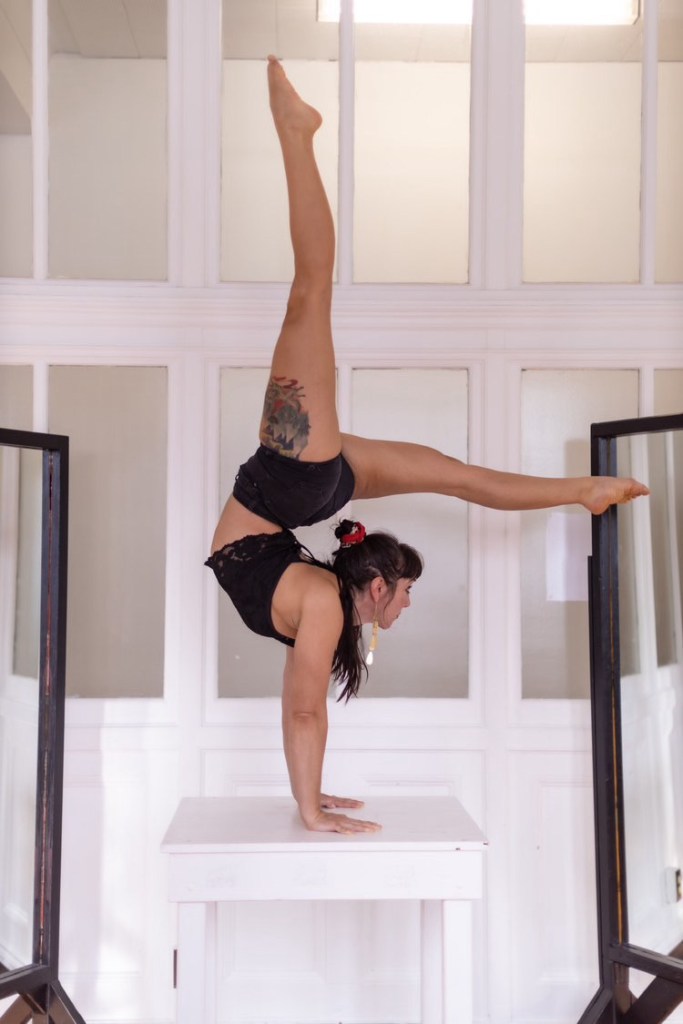
This level is appropriate for performing and act creation, the student keeps on advancing and building onto basics, fine tuning, tricks even on both sides (not for performance but body health), foot hooks, twist on regular poses (it’s a creative stage) and flow/line details. Endurance increases (for act formation): one learns combos/creative transitions and keep advancing the art of hand balancing, which in Contortion always includes back bending. There is also the use of a Contortion table for performing or tricks practice with the added challenge of height.
This is a level very appropriate to stay at if you don’t mean to go into circus level and what you learned so far can be taken to mastery in the years to come.
3 years to… infinity.
1-3 years for the naturally flexible.
Level 4 professional A (circus level)
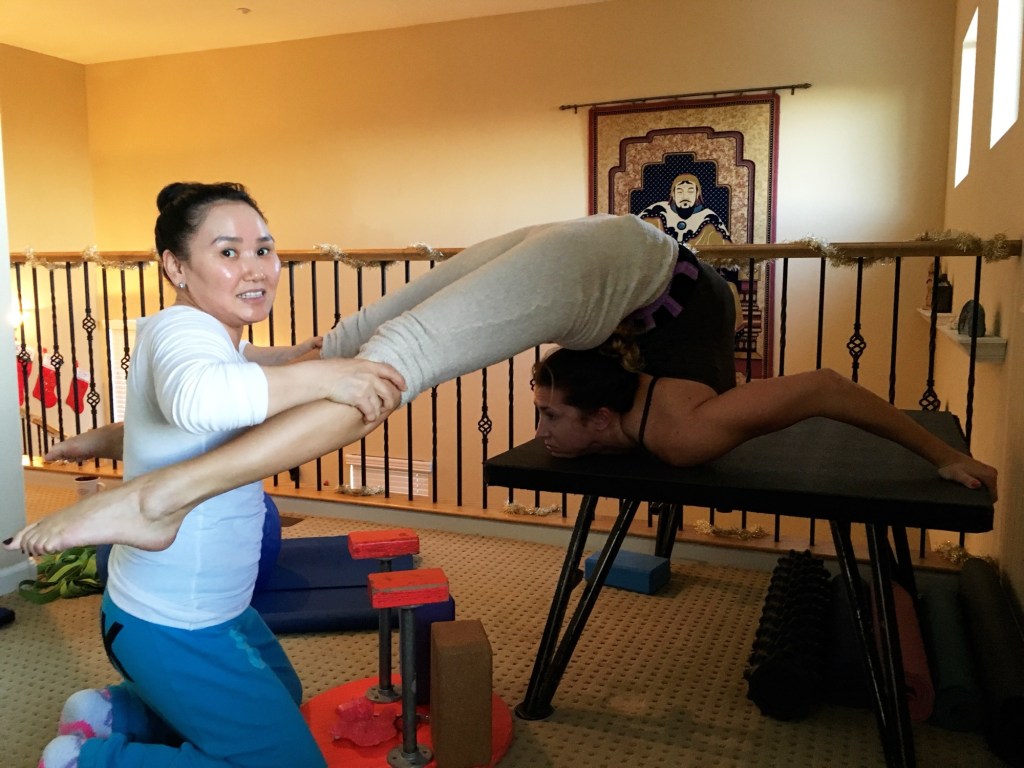
(Originally, classic contortion coaches wouldn’t train people who didn’t aim to reach this level and were above teen age. My coach Otgo Waller was one of the first coaches to train adults and opened the door for modern Contortion, now practiced by many adults all over the world).
This is the highest level of Contortion and definitely the age at which you started and natural flexibility matter. I’ll explain more below. This stage includes the introduction of top level tricks, like:
Crocodile to handstands
Single arm handstand and variations
Push up hook up handstands
Use of canes
Marinelli bend
Mexican handstands
This level strongly suggests a gymnastics background (or having started Contortion at a young age), natural flexibility (upper/mid back) or 15+ years experience.

People with full body or partial (upper/mid back) flexibility struggles with strength but can warm up faster and spend less time opening the body and more time trick fine tuning and strengthening. For the above tricks a lot of repetition is needed and they all require a very high level of balance, strength and flexibility, so if you take too long to warm up you won’t be able to stay fresh and have enough energy when tricks get this advanced. Non natural people needs greater attention to warm ups and therefore have less time for trick development. They need also more time to recover in between deep bends so can experience a slower progress, yet they improve. Also improvement tends to be more visible at the beginning of the journey and then it gets more “felt” within. The mind experiences a deep transformation through the years of Contortion. Stillness of mind becomes needed for a successful practice.
As of now Contortion has evolved into different forms of expression, I still take great inspiration from classical Mongolian Contortion and I believe it to be the highest form of the art, nonetheless everyone is able now to take their learnings and create their personal version of it, some adding it to their yoga or aerial practice. It’s empowering to have a strong understanding of the body and its endless ability to learn while navigating the mind’s limits. Knowing your own body proportions (long/short legs, long/short torso, height and such) will also help you to choose what fits your body type best and makes you happy, be it to perform or to practice for yourself.
It is also important not to compare yourself with others because as you can tell so many factors are to take in consideration and ultimately your goals with Contortion are yours only. Don’t forget to make this journey about not just pushing yourself, but also having fun and celebrating the little wins and lessons you pick along the way.
 Sofia Venanzetti